Neuschwanstein Castle was far more than a simple construction project; it was the physical manifestation of King Ludwig II’s romantic ideals. Driven by a desire to revive the atmosphere of medieval German knightly fortresses, Ludwig designed the site as a personal sanctuary. His plans were deeply influenced by the myths and legends found in the works of Richard Wagner, specifically Tannhäuser and Lohengrin. For the King, this was not just a home, but a grand tribute to the artistic and folkloric themes that defined his world.
While the castle appears to be a fairy-tale retreat, its history is tied to the harsh political realities of the late 19th century. Following Bavaria’s military defeat and its forced alliance with Prussia, Ludwig’s actual sovereign power was significantly diminished. Losing control over his army was a personal blow that he struggled to reconcile with his role as King.
In response, Neuschwanstein became an act of creative rebellion. Within these walls, Ludwig could escape the constraints of modern politics and inhabit an idealized version of his realm. By surrounding himself with the aesthetics of an absolute monarchy and a romanticized past, he created a space where his authority remained unchallenged.
Ultimately, Neuschwanstein stands as a monument to Ludwig’s resistance against the changing political landscape of his era. It remains the most prominent example of his various architectural pursuits—a place where the King could withdraw from a world he no longer recognized and find refuge in the legends of old.
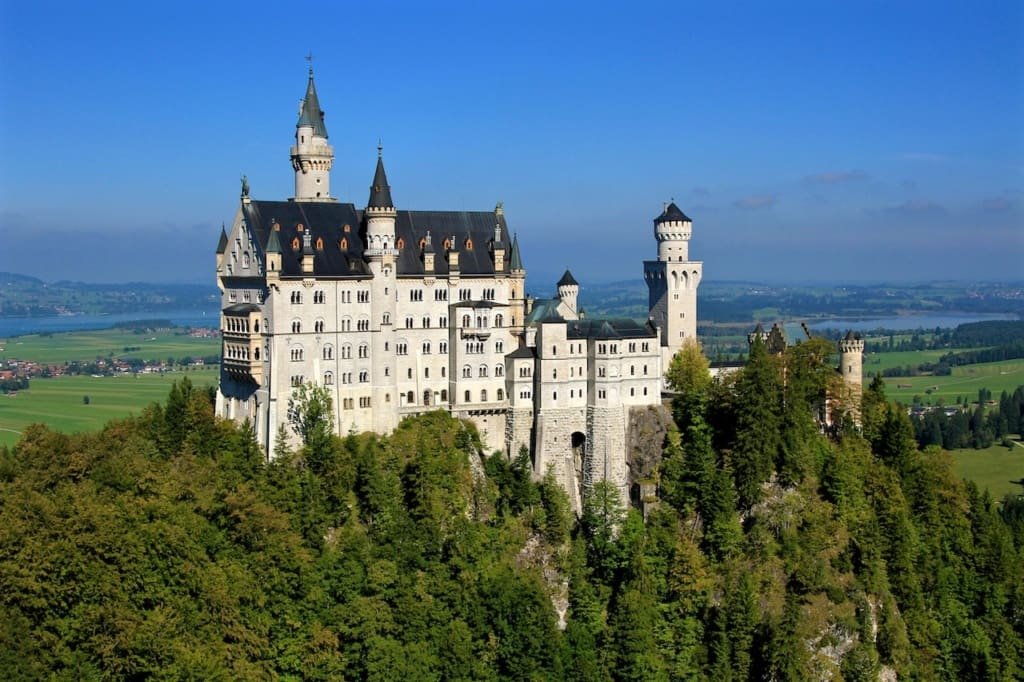
“More beautiful and habitable than the lower castle of Hohenschwangau”
The romantic interests of Ludwig II were largely shaped by his father, Crown Prince Maximilian II of Bavaria. In 1832, Maximilian began the Gothic restoration of the Schwanstein ruins, which significantly impacted Ludwig’s early interest in medieval aesthetics. Having spent a great deal of his childhood at this mountain retreat, Ludwig developed a lasting appreciation for the surrounding landscape.
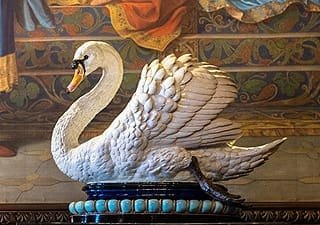
Inside Hohenschwangau, the decor featured numerous paintings and tapestries illustrating poetic tales and medieval myths, specifically the story of the Swan Knight, Lohengrin. Ludwig felt a strong personal bond with the character of Lohengrin, who was famously depicted in Richard Wagner’s 1850 opera. This connection went beyond mere admiration; the swan was the heraldic symbol of the Counts of Schwangau. As a descendant of this line, Ludwig viewed the legend as an integral part of his own family heritage.
King Maximilian II frequently incorporated swan motifs throughout the design of Hohenschwangau to merge his family’s history with an idealized view of the Middle Ages. Consequently, Ludwig’s future architectural endeavors, such as Neuschwanstein, served as a progression of his father’s work. These projects integrated his devotion to Wagner’s music and the era of chivalry with his ancestral identity and traditional Bavarian culture.
“The location is one of the most beautiful to be found”
Maximilian II developed a variety of paths and viewpoints to showcase the natural scenery near Hohenschwangau.
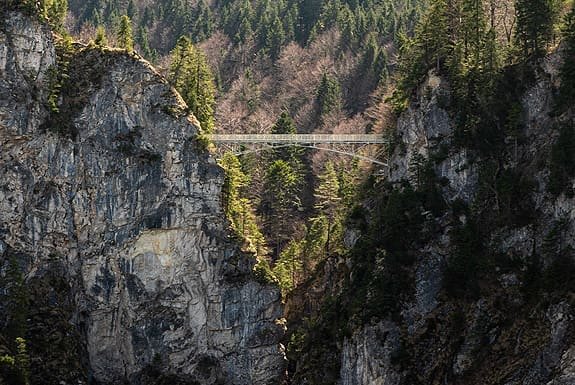
During the 1840s, he ordered the construction of the Marienbrücke, a bridge over the Pöllat Gorge, as a birthday gift for his wife, Marie, who was an active mountain enthusiast.
The “Jugend,” a narrow mountain ridge situated to the left of the Pöllat, offered exceptional views of the surrounding peaks and lakes. This location was a favorite of Maximilian II, who intended to build a viewing pavilion there in 1855. Prince Ludwig also spent significant time on the “Jugend” ridge, clearly influenced by the area’s impressive vistas.
“In the authentic style of the old German knights’ castles”
The ruins of two small fortresses, Vorder- and Hinterhohenschwangau, originally occupied the “Jugend” ridge. Ludwig II selected this historic foundation for his “New Hohenschwangau Castle”—a title that was only replaced by “Neuschwanstein” after his passing. He aimed to build a fortress that surpassed Hohenschwangau in medieval authenticity while incorporating the latest technological innovations of the time.
In 1867, Ludwig II visited the recently restored Wartburg Castle, which significantly influenced his vision. He was particularly moved by the Singers’ Hall, the legendary site of the “Singers’ Contest.” As a result, the Wartburg became a major architectural reference for his project. Architect Eduard Riedel was commissioned to merge these historical influences with the theatrical set designs of Christian Jank, a Munich-based scene painter, to create the castle’s final plans.
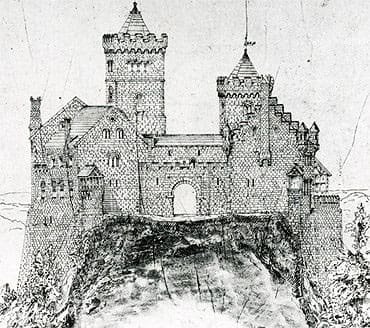
“Looking forward to living there one day (in three years)”
The construction of the castle proved far more time-consuming than King Ludwig II had anticipated. Given the project’s massive scale and the logistical difficulties of the mountain terrain, architects and craftsmen often had to work day and night to meet the King’s demanding deadlines.
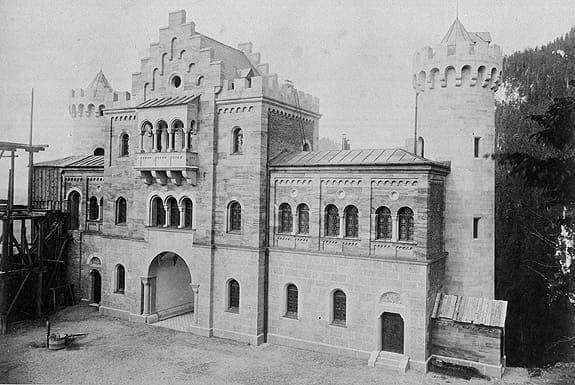
The foundation stone for the “New Castle” was laid on September 5, 1869. The Gateway Building was the first section finished, serving as Ludwig’s primary residence for several years. It wasn’t until 1880 that the Palas, or main building, reached its topping-out ceremony; the King finally moved into these quarters in 1884.
As Ludwig became more isolated, his architectural requirements shifted. He scrapped plans for guest rooms in favor of a “Moorish Hall” featuring a fountain, though this specific room was never completed. Additionally, from 1880 onward, the space originally intended as a Writing Room was redesigned as a small indoor grotto.
The planned Audience Room also underwent a major transformation, evolving into a grand Throne Room. Designed as a symbolic monument to the monarchy and modeled after the legendary Hall of the Holy Grail, it was never intended for hosting public audiences. Integrating such a massive hall into the existing Palas structure required the use of advanced steel construction techniques.
In the west wing of the Palas, initial designs included a “knights’ bath,” intended to mirror the ceremonial baths of the Knights of the Holy Grail. Today, this area serves a practical purpose as a staircase for tourists exiting the castle.